Books › Neuroscience & Brain Function
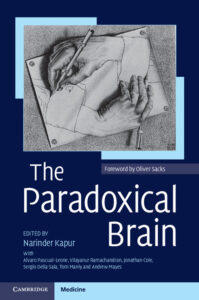
The Paradoxical Brain
Share
Book at a glance
- Area
- Neuroscience & Brain Function
- Editors
- Kapur N
- Publisher
- Cambridge University Press
- Year
- 2011
- Pages
- 466
- ISBN
- 9780521115575
What's inside
- Paradoxical functional facilitation and recovery in neurological and psychiatric conditions (Kapur)
- Paradoxes in neurorehabilitation (Manly, Robertson, Kapur)
- Paradoxical functional facilitation with noninvasive brain stimulation (Najib, Pascual-Leone)
- Paradoxical phenomena in brain plasticity (Kolb, Teskey)
From the publisher (Cambridge University Press) → DOI 10.1017/CBO9780511978098 →
Edited by Narinder Kapur with Alvaro Pascual-Leone, Vilayanur Ramachandran and others, with a foreword by Oliver Sacks, this book gathers findings where the brain behaves against expectation: better performance after a lesion or sensory loss, forgetting that helps learning, talent alongside autism, and the paradoxes of psychosurgery and electroconvulsive therapy. Its 24 chapters span neurology, psychiatry, development, aging and plasticity.
It is written for researchers and clinicians in the brain sciences. Neurofeedback practitioners will find the chapters on plasticity, neurorehabilitation and noninvasive brain stimulation a useful check on simple deficit models of the brain.
Chapters
- The paradoxical nature of nature Narinder Kapur, Alvaro Pascual-Leone, Tom Manly, Jonathan Cole
- Paradoxical effects of sensory loss Alvaro Pascual-Leone, Souzana Obretenova, Lotfi B. Merabet
- Paradoxical functional facilitation and recovery in neurological and psychiatric conditions Narinder Kapur
- Paradoxes in neurorehabilitation Tom Manly, Ian H. Robertson, Narinder Kapur
- The paradoxical self Vilayanur Ramachandran, William Hirstein
- Paradoxical psychological functioning in early child development David J. Lewkowicz, Asif A. Ghazanfar
- Cognitive ageing: a positive perspective Shira Zimerman, Lynn Hasher, David Goldstein
- Paradoxes of learning and memory Henry L. Roediger, Andrew C. Butler
- The paradox of human expertise: why experts get it wrong Itiel E. Dror
- Paradoxes in Parkinson's disease and other movement disorders Ashwani Jha, Peter Brown
- Paradoxical phenomena in epilepsy Steven C. Schachter
- Paradoxical creativity and adjustment in neurological conditions Indre V. Viskontas, Bruce L. Miller
- Paradoxical functional facilitation with noninvasive brain stimulation Umer Najib, Alvaro Pascual-Leone
- Unexpected benefits of allergies and cigarette smoking: two examples of paradox in neuroepidemiology Judith Schwartzbaum, Linda Karavodin, Narinder Kapur, James L. Fisher
- The paradox of autism: why does disability sometimes give rise to talent? Simon Baron-Cohen, Emma Ashwin, Chris Ashwin, Teresa Tavassoli, Bhismadev Chakrabarti
- Paradoxes in creativity and psychiatric conditions Jonathan Hurlow, James H. MacCabe
- The paradox of psychosurgery to treat mental disorders Perminder S. Sachdev
- The paradox of electroconvulsive therapy Angela Merkl, Malek Bajbouj
- Paradoxes of comparative cognition Howard C. Hughes
- Paradoxical phenomena in brain plasticity Bryan Kolb, G. Campbell Teskey
- Immature neurons in the adult brain. Breaking all the rules J. Martin Wojtowicz
- The paradoxical hippocampus: when forgetting helps learning Howard Eichenbaum
- Paradoxical effects of drugs on cognitive function: the neuropsychopharmacology of the dopamine and other neurotransmitter systems Roshan Cools, Esther Aarts, Mitul A. Mehta
- The paradoxical brain – so what? Narinder Kapur, Tom Manly, Jonathan Cole, Alvaro Pascual-Leone